The Architectures of Autonomy: Strategic AI and Agentic Workflows in NetSuite
The enterprise landscape is currently navigating a move from static systems of record to dynamic systems of intelligence. For the NetSuite ecosystem, this transition is defined by the emergence of agentic workflows. These are autonomous AI entities capable of reasoning, planning, and executing multi-step business processes with minimal human oversight. At Swyft ERP, we specialize in the deployment of these intelligent layers, ensuring that your ERP functions as an active operational partner.
The Emergence of the Agentic Era
Traditional automation has long relied on deterministic logic. While effective for simple tasks, these rigid frameworks often fail when confronted with unstructured data or ambiguous conditions. The current wave of innovation leverages Large Language Models (LLMs) to provide a reasoning layer for the ERP.
An agentic workflow treats a business objective as a goal to be solved through iterative planning. When an agent receives a request, it evaluates the available tools within NetSuite, such as SuiteQL queries or RESTlet endpoints, and determines the most efficient sequence of actions to achieve the desired outcome. This allows the system to handle the complex exceptions that typically stall traditional workflows.
The Transformation of Mundane Operations
To understand the practical impact of this technology, it is helpful to examine the specific NetSuite operations that have transitioned from manual labor to autonomous execution.
| NetSuite Operation | Standard Manual Process | AI-Enabled Autonomous Process |
| Bank Reconciliation | A staff accountant manually matches bank statement lines to GL entries, investigating every date or amount variance. | AI agents perform semantic matching across thousands of lines, auto-resolving partial payments and flagging only high-risk anomalies. |
| A/P Invoice Entry | AP clerks manually type data from PDFs into NetSuite or manage rigid OCR templates that frequently break. | Vision-capable agents extract intent and data from any invoice format, automatically assigning the correct GL code based on historical context. |
| Customer Collections | A collector looks at an aging report and sends generic “friendly reminder” emails to all overdue accounts. | Agents analyze payment history and sentiment to draft hyper-personalized dunning letters, identifying which customers need a phone call versus a simple reminder. |
| Lead Qualification | Sales Ops manually reviews form fills and LinkedIn profiles to assign a subjective “score” to a lead. | Agents research the prospect’s recent company news and financial filings to provide a narrative “Intent Score” directly within the CRM record. |
| Financial Reporting | A Controller spends hours exporting data to Excel to create narrative summaries for the Board of Directors. | Narrative Insight agents synthesize real-time SuiteQL data into professional executive summaries, highlighting the “why” behind the numbers. |
| Inventory Planning | A manager uses static “Min/Max” levels that fail to account for seasonal shifts or global supply chain delays. | Predictive agents analyze multivariate data sets to autonomously adjust reorder points, preventing stockouts before they occur. |
| Expense Auditing | A manager skims receipts to ensure employees are following the corporate travel policy. | Agents audit 100 percent of expense lines against corporate policy and SOC 2 compliance standards, flagging non-compliant spend in real-time. |
Strategic Technical Architecture: MCP and Efficiency
The ability to deploy autonomous agents within NetSuite is underpinned by the NetSuite AI Connector Service and the Model Context Protocol (MCP). Originally developed as an open standard, MCP allows different AI models to communicate securely with the NetSuite environment. This model-agnostic approach ensures that a business is not locked into a single AI provider.
However, a sophisticated implementation requires a focus on computational efficiency. Standard MCP integrations can be heavy in terms of token consumption, leading to unnecessary operational costs. Our approach at Swyft ERP emphasizes optimized API solutions that maintain high reasoning capabilities while minimizing the token overhead. We prioritize architectures that deliver high performance without the “surprise overages” often associated with unoptimized AI usage.
Data Sovereignty and Security in the AI Ecosystem
As AI moves from generating text to executing transactions, the stakes for security and data privacy have increased. A primary concern for any C-suite executive is the protection of proprietary financial data.
- Local AI and Data Privacy: We advocate for the use of local AI models or private cloud instances. This ensures that sensitive NetSuite data remains within your controlled perimeter and is never used to train public models.
- Adversarial Prompting and Injection: One of the most significant risks in modern AI is prompt injection. This occurs when an actor steers an AI to bypass internal controls or leak sensitive information.
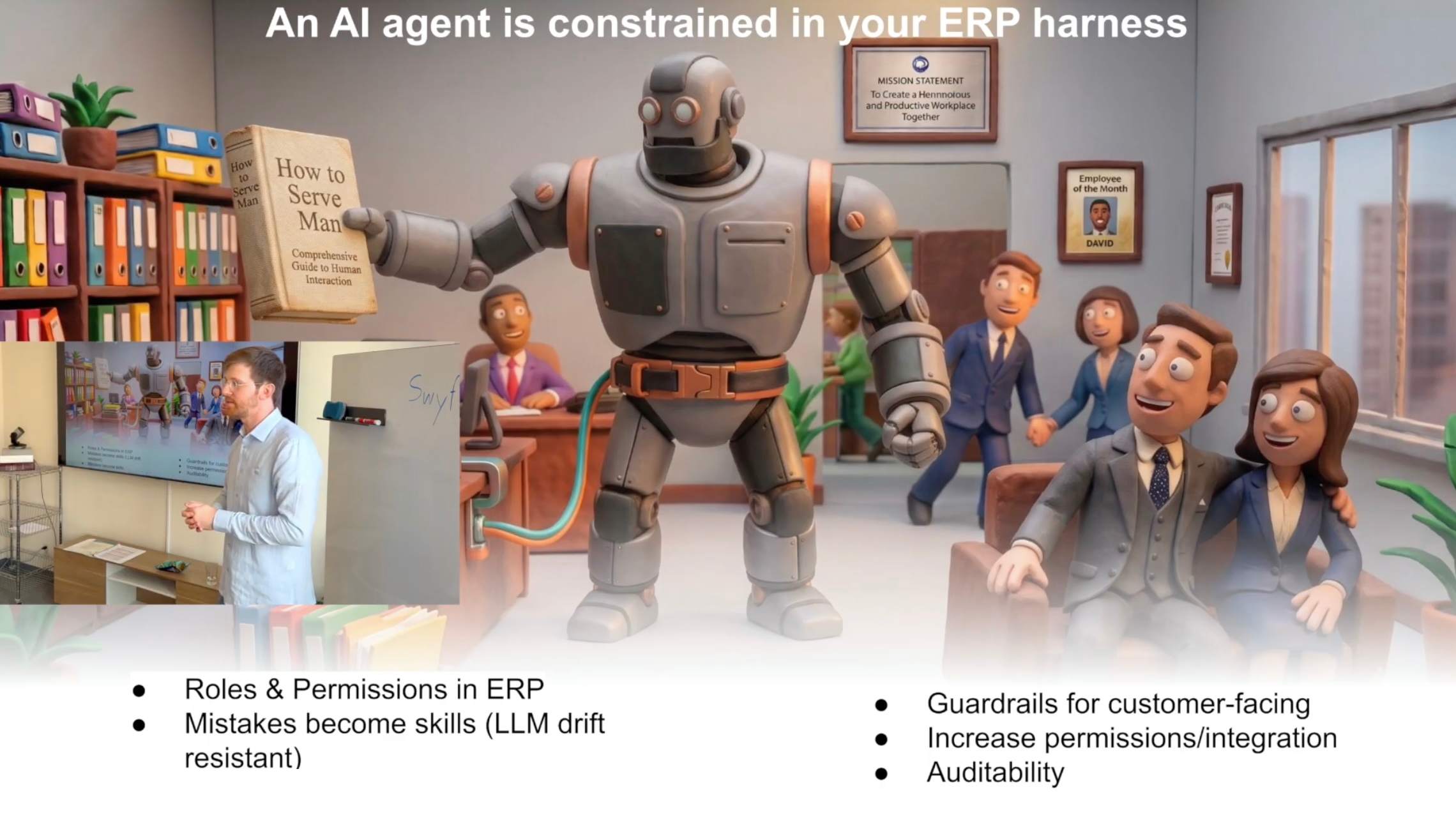
- Independent Guardrails: To mitigate these risks, we implement governance frameworks where the security guardrails exist outside of the AI’s reasoning engine. This architectural separation ensures that safety protocols remain intact even if the LLM encounters an unfamiliar edge case.
Operational Excellence through Financial Agents
The most immediate ROI for agentic AI is found within the finance department, where high-volume, data-intensive tasks are common.
Automated Financial Exception Management
Closing the books remains a bottleneck for many firms. Agentic AI can be used to proactively identify and resolve anomalies throughout the month. These agents scan transactions for mismatches between bank statements and General Ledger entries, evaluate the materiality of the variance, and either auto-reconcile the record or escalate the issue with a pre-written investigation report for the Controller.
Intelligent Accounts Receivable
AR inquiries arrive as unstructured communications. An agentic assistant can monitor a shared inbox, categorize the intent of an email, retrieve the relevant invoice data from NetSuite, and draft a personalized response. This process handles the administrative burden of standard inquiries, allowing the finance team to focus on high-value dispute resolution.
The Semantic Layer and Data Integrity
The success of any agentic workflow is dependent on the quality of the underlying data. As we move toward hyper-automation, the role of the semantic layer becomes critical. NetSuite’s unified data model provides a natural advantage, but it still requires diligent management.
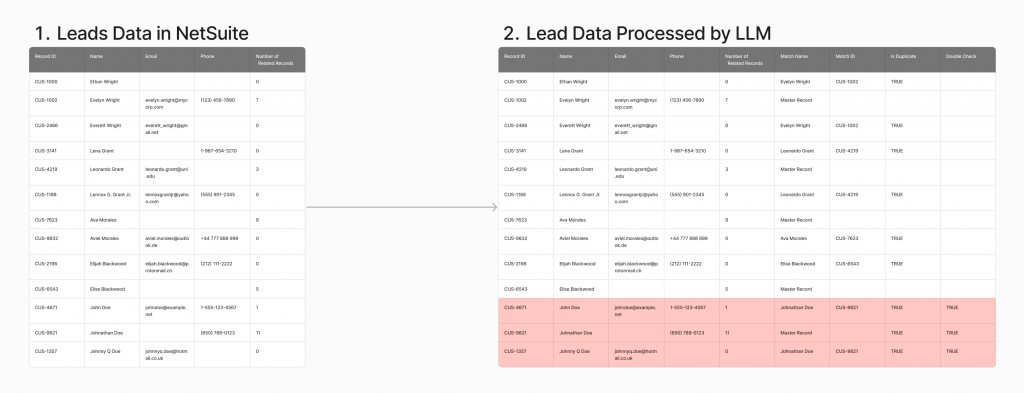
We utilize AI-powered semantic de-duplication to ensure your “System of Truth” is actually accurate. Traditional de-duplication often misses records like “John Doe” versus “Johnathan Doe” because it lacks context. Semantic cleaning uses vector embeddings to understand the meaning of the data, ensuring that your agents are grounded in accurate, unique records. This prevents the “hallucinations” that occur when an AI attempts to reason across fragmented data sets.
Phased Implementation and Governance
A 90-day implementation of agentic AI requires a disciplined approach to governance. We establish a “Human-in-the-Loop” framework to maintain executive control:
- Observability: Using tools like Agent Trace, we record every action an agent takes, including the tools it chose and its internal reasoning steps. This creates a permanent audit trail for compliance.
- Risk Tiers: We categorize tasks into tiers. Low-risk tasks may be fully autonomous, while high-stakes decisions, such as large purchase orders or GL adjustments, require a human to authorize the agent’s recommendation.
- Process Clarity: Before any AI is deployed, we audit the existing business process. An agentic workflow can only be successful if the underlying accounting logic is sound.
The transition to an autonomous enterprise is a strategic journey. By focusing on architectural integrity, data sovereignty, and disciplined governance, Swyft ERP ensures that your NetSuite environment is prepared for the next decade of digital transformation.
Beyond the AI hype there are practical real-world use cases for implementing AI workflows into your ERP and business processes including:
- Automating manual business processes involving repetitive actions.
- Document automation – Ingesting Invoice or PO PDFs in combination with OCR to automatically create transaction records. While NetSuite is continuing to roll out native AI capabilities they are costly and may lack the nuance and specific use cases your business requires.
- CRM automation – Ingesting Emails and auto-assigning to Projects, Tasks, Sales Reps with email summarization and priority.
- Developing business-specific customizations rapidly.
- Semantic data cleaning.
Simple Example of Semantic De-Duplication:
Records in NetSuite may be duplicates, but not detected by NetSuite as duplicates because there is not an exact match between John Doe and Johnathan Doe or may have been entered by multiple employees with slightly different information. AI can semantically understand these similarities to alert employees to double-check and merge similar records:
If you’re looking to automate processes within your ERP or CRM please don’t hesitate to contact us and book a meeting for a free consultation.